


You might feel anxious if xud3.g5-fo9z shows in your terminal as you run your Python script. Although there’s no need to panic, since there is a small set of possible issues you can refer to. This error likely signifies some kind of typo, an incorrect environment, a faulty installation, or even some copy-paste error in your code.
In the following, you can find a stepwise tutorial with possible resolutions to xud3.g5-fo9z. You will find a breakdown and tips to prevent the error. You might even find a checklist, a comparison table, and charts.
Let’s fix this together.
What is xud3.g5-fo9z in Python?
Table of Contents
- What is xud3.g5-fo9z in Python?
- Common Reasons for the Error xud3.g5-fo9z is Raised
- How to Fix the xud3.g5-fo9z Python Error Step by Step
- Quick Fix Checklist for First-Time Users
- Comparison Table of Possible Causes and Fixes
- Comparison: Common Causes vs Best Fixes
- What Should You Try First? A Quick Decision Guide
- How To Avoid Getting the xud3.g5-fo9z Error in Python
- When the Problem Isn’t Your Code
- What to Do If None of the Fixes Work
- FAQ
In layman’s terms, xud3.g5-fo9z is pseudocode for a nonexistent Python module, function, or error type. You can think of this error as an informal way to refer to a more general error concerning something gone wrong either in your code, your environment, or your configuration. This error is more of a symptom than a disease. You need to trace this error to the root cause.
So where does it come from? Usually one of a few places:
- An error string Python prints when it can’t find or parse something
- A malformed identifier, meaning a name that isn’t valid in Python
- A dependency artifact left behind by a broken or partial install
- A corrupted reference from encoding or copy-paste issues
- An auto-generated or temporary file name created by a tool or build process
Before resolving the error, understand the context in which it occurs. Considering the context, location is the most substantial indicator of the source of the error.
Look for xud3.g5-fo9z in these common spots:
- Terminal output when you run your script
- Traceback, the multi-line error message Python prints
- Script file, inside your own code
- Package install log, when installing with pip
- IDE console, inside VS Code, PyCharm, or similar editors
Once you know where it appears, you’re already halfway to fixing it.
Common Reasons for the Error xud3.g5-fo9z is Raised
Most of the time, the cause falls into one of the categories below. Skim through and see which one sounds closest to your situation.
1. Typo or Invalid Module/Package Name
This is the most common culprit. You may have misspelled an import, a variable, or a function name. Python can’t find what you’re asking for, so it complains. Even one wrong character counts.
2. Corrupted Dependency or Installation Issue
Sometimes a package doesn’t install cleanly. Maybe your connection dropped mid-install, or two packages clashed. The result is a broken reference that doesn’t behave the way it should.
3. Virtual Environment Misconfiguration
You might be running your script in the wrong environment. The package you need lives in one place, but your script is looking somewhere else. This happens a lot, and it’s very fixable.
4. Copy-Paste or Encoding Problem
Pasting code from a website, PDF, or chat can drag in invisible characters. They look fine to your eyes but confuse Python. This one is sneaky because the code looks perfect.
5. IDE or Interpreter Path Mismatch
It is possible that your code is executing in an Integrated Development Environment (IDE) while throwing an error in the terminal due to a version mismatch. In this case, the IDE and the terminal are out of sync.
6. Reference to an Auto-Generated or Temporary File
Some IDEs or build/caching tools may create temporary or auto-generated files with odd names. If you are seeing names it xud3.g5-fo9zthis,it is likely a temporary or auto-generated file.
How to Fix the xud3.g5-fo9z Python Error Step by Step
Here’s the heart of the guide. Work through these steps in order. Don’t skip ahead. The early steps are quick wins, and they solve the problem more often than you’d expect.
1. Read the Full Error Message Carefully
Don’t just glance at the scary parts. Read the whole traceback.
Look for the file name, the line number, and the stack trace. Then check the lines right before and after xud3.g5-fo9z. Python usually tells you exactly where things went wrong if you slow down and read it.
Quick tip: The bottom line of a traceback often holds the most useful clue.
2. Check Your Spelling in Code

Now go to that exact line number. Review your imports, variable names, function names, and file names.
Compare them against the official documentation for whatever package you’re using. A single wrong letter, an extra dot, or a swapped character can trigger the whole mess.
Example: Writing import reqeusts instead of import requests is enough to break everything.
3. Confirm the Package is Installed Correctly
If a package is involved, make sure it’s actually installed. In your terminal, run:
pip listThis shows every package in your current environment. Look for the one you need. If it’s missing or looks broken, reinstall it:
pip install --force-reinstall package-name4. Activate the Right Virtual Environment
This step fixes a surprising number of mystery errors. Make sure you’re working inside the correct virtual environment.
Activate it like this:
# macOS / Linux
source venv/bin/activate

# Windows
venv\Scripts\activate
Then confirm your Python version:
python --versionMake sure your IDE uses this same interpreter. If your terminal and editor disagree, you’ll keep getting confusing results.
5. Update or Reinstall Dependencies
If things still feel broken, refresh your setup. First, upgrade pip itself:
python -m pip install --upgrade pipThen reinstall the key packages your project needs. Removing and reinstalling clears out partial or corrupted installs.
6. Look for Encoding or Hidden Characters
If you copied code from somewhere, this might be your problem. Hidden characters won’t show up visually, but Python sees them.
The fix is simple: retype the suspicious line by hand. Then save your file with clean UTF-8 encoding. Most editors let you set this in the bottom bar or in the settings.
7. Clear Cache and Temporary Files
Old compiled files can interfere with fresh code. Look for a folder called __pycache__ and delete it. It rebuilds automatically and safely.
Then restart your terminal or IDE for a clean slate. Sometimes a simple restart clears the issue entirely.
8. Test With a Minimal Example
Still stuck? Strip your code down to the smallest version that still triggers the error.
Remove everything that isn’t essential. This isolates the problem and shows you exactly which piece is responsible. It’s one of the most powerful debugging habits you can build.
Quick Fix Checklist for First-Time Users
Short on time? Run through this checklist from top to bottom. It covers the fastest, highest-impact fixes.
- Read the full traceback
- Check your spelling on the flagged line
- Confirm the correct interpreter is active
- Verify the package is installed
- Recreate your virtual environment if needed
- Test with a minimal code sample
If you’re wondering “How do I quickly fix xud3.g5-fo9z?”, start at the top of this list and stop the moment your error disappears.
Comparison Table of Possible Causes and Fixes
Use this table to match your situation to a fix fast. Find the cause that sounds like yours, then jump straight to the recommended action.
Possible Cause | What It Means | How to Check | Recommended Fix |
|---|---|---|---|
Typo in code | Invalid import, variable, or function name | Review the traceback and the source line | Correct the spelling |
Broken package install | Dependency didn’t install properly | Run | Reinstall the package |
Wrong virtual environment | Script runs in the wrong environment | Compare the terminal and the IDE interpreter | Activate the correct environment |
Encoding issue | Hidden or special characters break parsing | Open the file and inspect the line | Re-type and save cleanly |
Cached files | Old compiled files interfere | Look for | Clear the cache and rerun |
IDE configuration mismatch | The editor uses a different Python binary | Check IDE settings | Set the correct interpreter |
Comparison: Common Causes vs Best Fixes
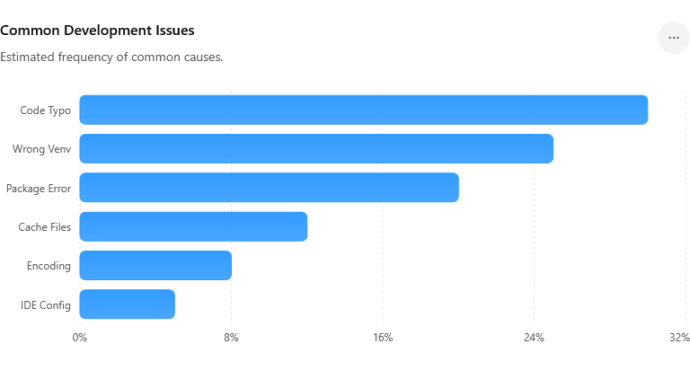
Visuals make patterns easier to spot. We can’t draw a chart for you here, but the data below is chart-ready. You can drop these points into a bar chart, pie chart, or scatter plot in seconds.
Important: The percentages below are illustrative estimates based on common beginner patterns, not measured statistics. They’re meant to give you a rough sense of priority, nothing more.
What Should You Try First? A Quick Decision Guide
Not sure where to start? Here are some simplified steps.
- If the error points to a line in your own code, start with a spelling check. (Step 2)
- If the error refers to a package or an import, verify the installation check and the environment check. (Steps 3 and 4)
- If the code works on another machine but not yours, check the environment and the interpreter.
- If you recently copied and pasted code from the internet, check for hidden characters. (Step 6)
- If nothing was changed and the code broke, try clearing the cache and restarting. (Step 7)
These steps help you avoid randomly trying different solutions. Match the observed behavior to a probable cause and so on.
How To Avoid Getting the xud3.g5-fo9z Error in Python
Keep in mind that the small steps help prevent a lot of problems.
- Use a Virtual Environment for Every Project: Keep each project’s packages separate so they never clash.
- Keep Your Package Versions Documented: Save them in a
requirements.txtfile so your setup stays reproducible. - Avoid Copying Code From Unreliable Sources: If you must copy, paste into a plain-text editor first to strip hidden characters.
- Double-Check the Interpreter in Your IDE: Make sure your editor and terminal point to the same Python.
- Run Small Tests After Every Big Change: Catch problems early, while they’re still small and easy to trace.
When the Problem Isn’t Your Code
You may not even be the one at fault. The problem could be:
- A bug from a third-party package from an external library
- An artifact from an auto-generation
- A mismatch from a build or deployment environment
- Corrupted local setup that needs a clean reinstall
The good news? These are all fixable. They are just going to require a new environment or an updated package.
What to Do If None of the Fixes Work
You have tried everything, and the problem persists. Here is the last plan of action:
- Type the exact text from the traceback and search it online
- Go over what you did last and redo it in reverse order
- Build a fresh virtual environment from scratch
- Reinstall Python if none of the previous helped
- Request help on a forum, post the full error, and post the previous steps you took to solve the problem.
When you ask for help, include the complete traceback. The more context you give, the faster someone can spot the issue.
FAQ
What does xud3.g5-fo9z means in Python?
It isn’t an official Python term. It usually appears as a symptom of a typo, broken install, wrong environment, or hidden character. Trace it back to its source to fix it.
Is xud3.g5-fo9z a real Python module?
No. It’s not a standard module, function, or library. It’s a placeholder-style string pointing to a deeper setup or code issue.
Can a virtual environment cause this error?
Yes, quite often. If your script runs in the wrong environment, it can’t find the packages it needs. Activating the correct environment usually fixes it.
How do I know if a package is the problem?
Run pip list to see what’s installed. If the package is missing, broken, or the wrong version, that’s likely your culprit. Reinstall it to confirm.
Should I reinstall Python to fix it?
Only as a last resort. Try the spelling, environment, and package fixes first. Reinstalling Python is rarely necessary and should be your final move.
Summary
Seeing xud3.g5-fo9z in Python, it feels alarming, but it almost always traces back to something small and fixable. Usually, it’s a typo, an environment mismatch, a broken dependency, or some corrupted text from a copy-paste.
Here’s your game plan: start with the traceback, then check your spelling, confirm your environment, and verify your installs. Work from the simplest fixes up to the harder ones. The comparison table and chart-ready data show you which causes are most common and which fixes give the best results.
Most of all, stay calm. Debugging is a normal part of learning Python, not a sign you’re doing it wrong. Take it one step at a time, and you’ll have this sorted out before you know it. You’ve got this.


No Comments